Follow us on LinkedIn for the latest industry news!


Category: Thermoforming

This is the seventh post in our series from our Thermoforming Handbook, a guide that, until now, was only available to our customers and partners. We’re releasing the whole thing in a series of posts right here on our blog.

We’ve previously released:

If you’re someone who uses custom plastic manufacturing professionally and you’re interested in getting your own copy, just send us a message and we’ll be happy to send you one. As always, these are general guidelines. Any project or design needs to be reviewed by a qualified thermoforming professional before it goes into production, and the sooner you get one of those qualified professionals involved in the process, the smoother things tend to go.  If you’re looking for a qualified professional, we know a few who would be happy to help.


The last part of the thermoforming process is finishing.  This term can encompass anything that happens after the final part is trimmed, including painting, silk-screening, the attachment of fasteners and in some cases even assembly and logistics.

Painting

Sure, you can thermoform in color, but there are a few reasons you still might want to consider painting.

Painting Options

  • Standard paints
  • Custom colored paints
  • Master batching with other suppliers
  • Metallic paints
  • Multi-color parts
  • Small lot customization

Silk Screening

Silk-screened text, images and logos can be used to brand, label and improve the aesthetics of thermoformed parts.

Specialty Finishes

EMI/RF Shielding – Special copper paint, used to block interference from electronic devices.

Hot Stamping – A process where metal foil text or graphics are permanently affixed to the thermoformed plastic.

Plating – Plated plastic is plastic that has been covered in a metal coating for the purposes of EMI/RF shielding, ESD prevention, wear resistance or a thermal or chemical barrier.

Embossing/Debossing – A process where heat is used to make a 3D impression/depression on the plastic, for a detailed feature like a logo  or graphic.

Attached Fasteners

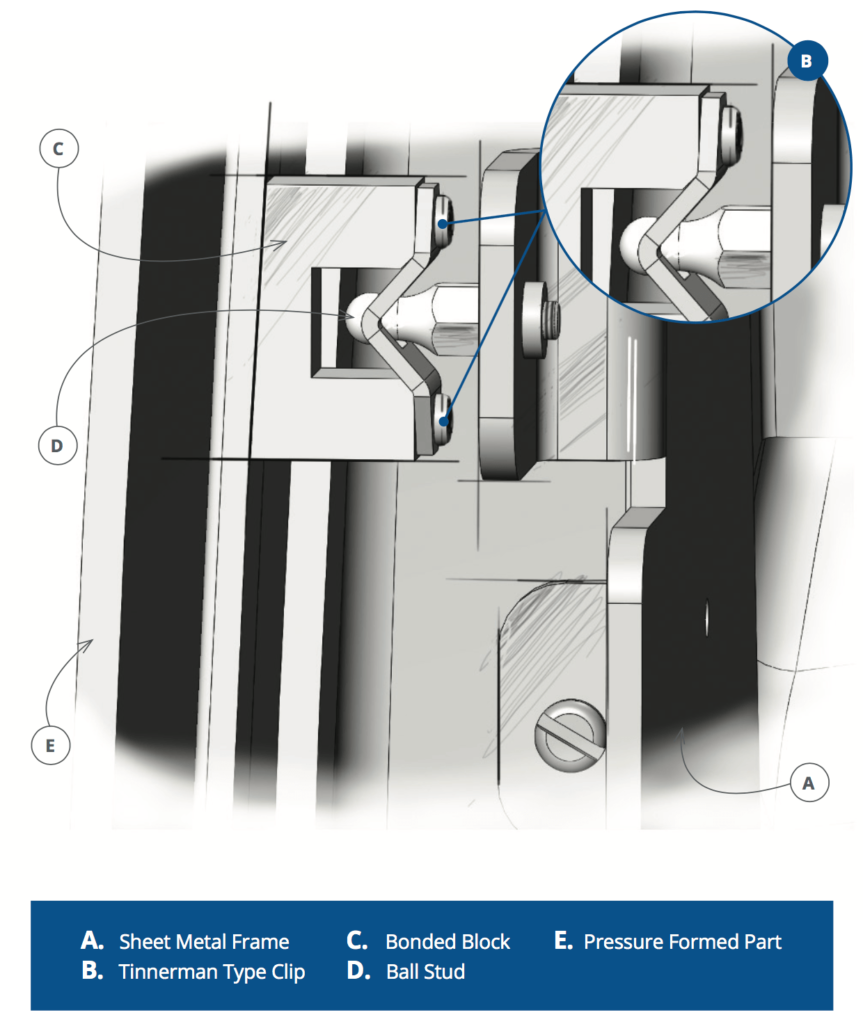
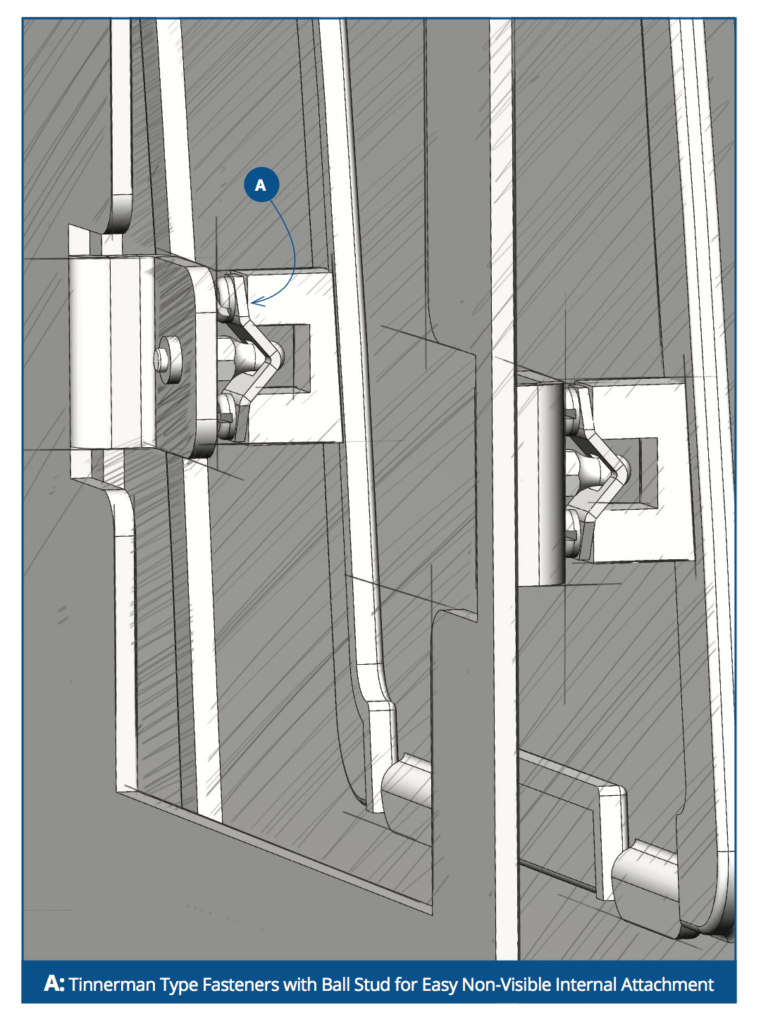
Bosses, inserts and other fasteners are attached with adhesive during the finishing process. They offer significant design flexibility, but can also increase costs.
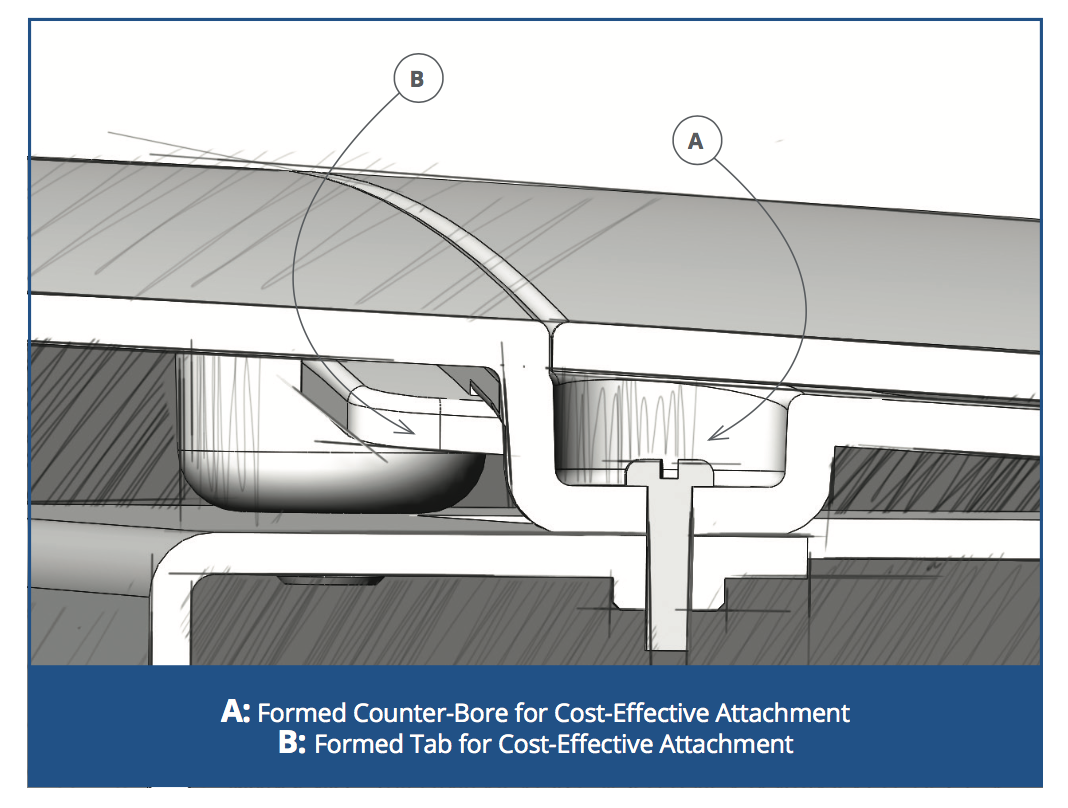
Pressure forming allows for molded attachment points like tabs, counter- bores or counter sinks.
Tech Tip: 

Fastening is one of the most important issues to address in the design ofplasticparts.Inthermoforming,itisnotpossibletomoldina boss or insert without it being visible on both surfaces of the part. Many types of fasteners and attachment options are available, and we are ready to work with you to meet the fastening requirements of your parts.

Molded-In Features

Molded-in features like snap-fits, tabs and receiving slots are affordable fastening options, and don’t generally add significantly to the total project cost.
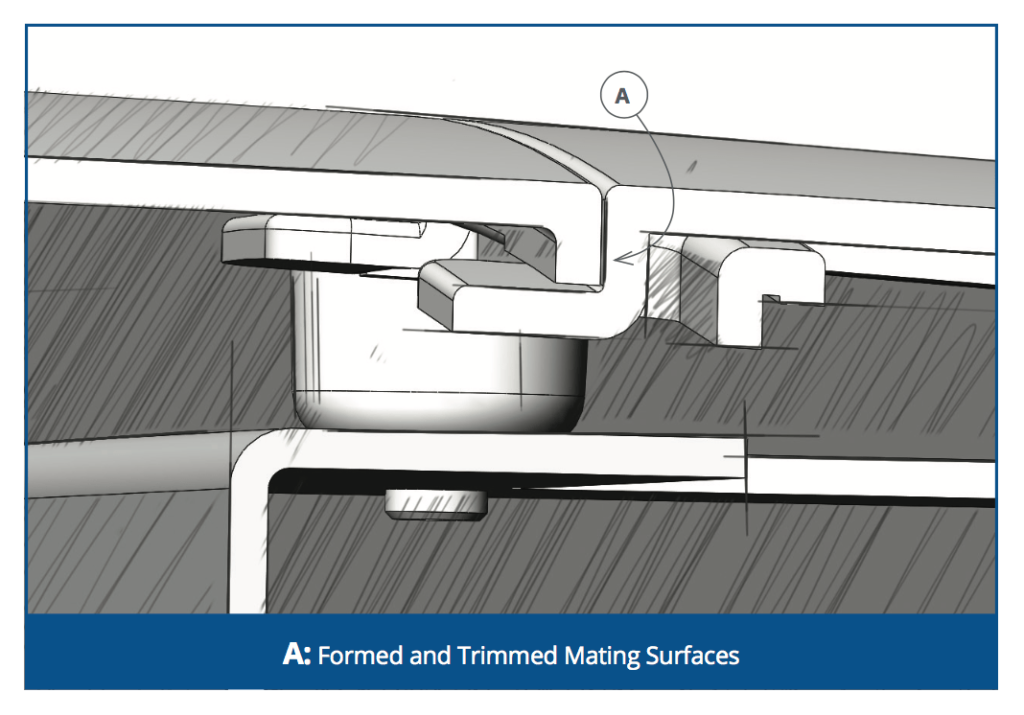
Molded In Thermoforming Features

Molded In Counter-Bore Fasteners Thermoforming

Bonded Bosses With Inserts

Bonded bosses with inserts can help to form a secure attachment between two parts, but they do add some costs to building the part.
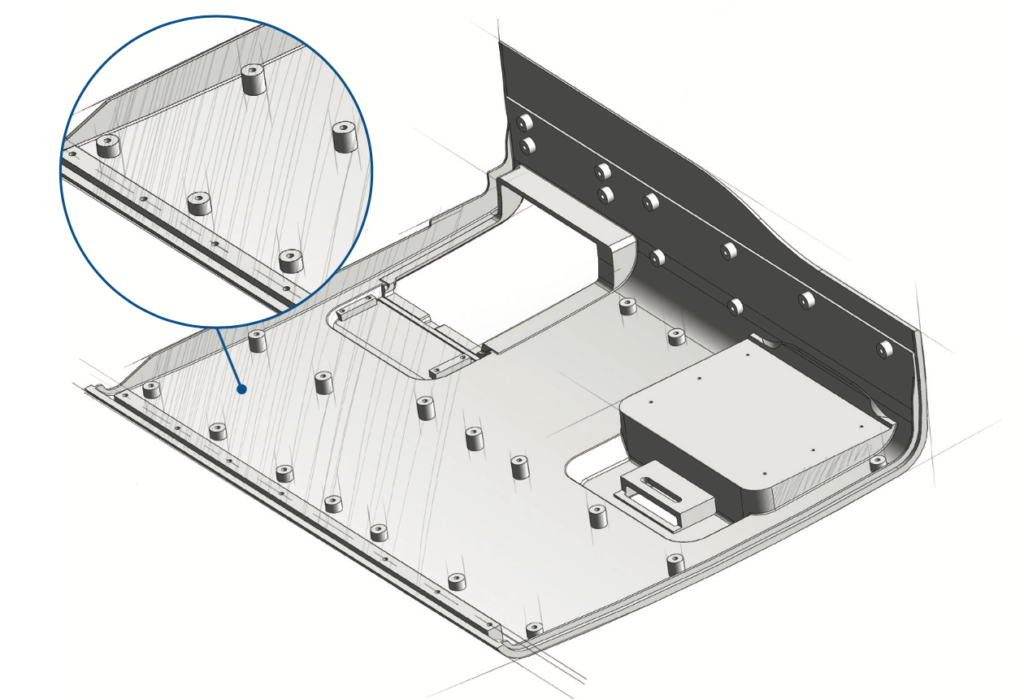
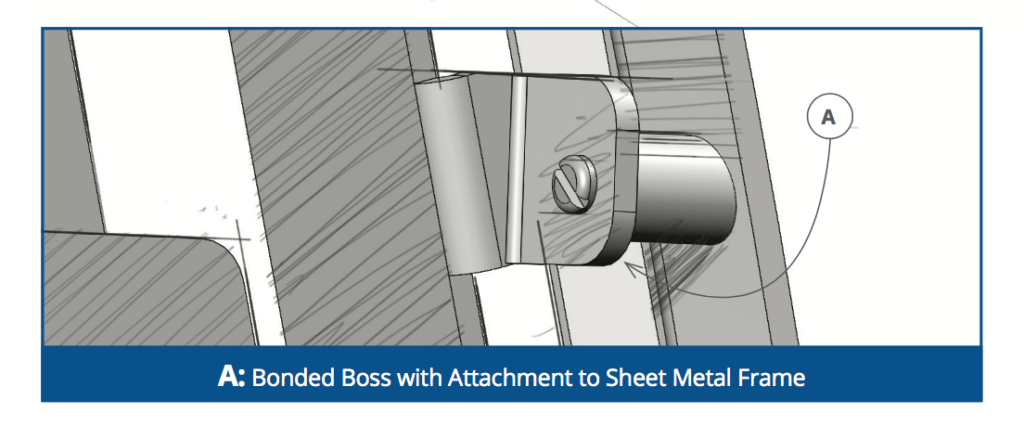
Bonded Bosses With Inserts

Bonded Bosses With Sheet Metal Attachments

Tech Tip

Unlike injection molding or other processes, our bosses can be added, subtracted or moved without any impact to tooling.

We’re Ready to Help

Have questions about finishing on your next thermoforming project? We’d be happy to help.  Get in touch today.
Category: Thermoforming

This is the sixth post in our series from our Thermoforming Handbook, a guide that, until now, was only available to our customers and partners. We’re releasing the whole thing in a series of posts right here on our blog.

We’ve previously released:

If you’re someone who uses custom plastic manufacturing professionally and you’re interested in getting your own copy, just send us a message and we’ll be happy to send you one. As always, these are general guidelines. Any project or design needs to be reviewed by a qualified thermoforming professional before it goes into production, and the sooner you get one of those qualified professionals involved in the process, the smoother things tend to go.  If you’re looking for a qualified professional, we know a few who would be happy to help.


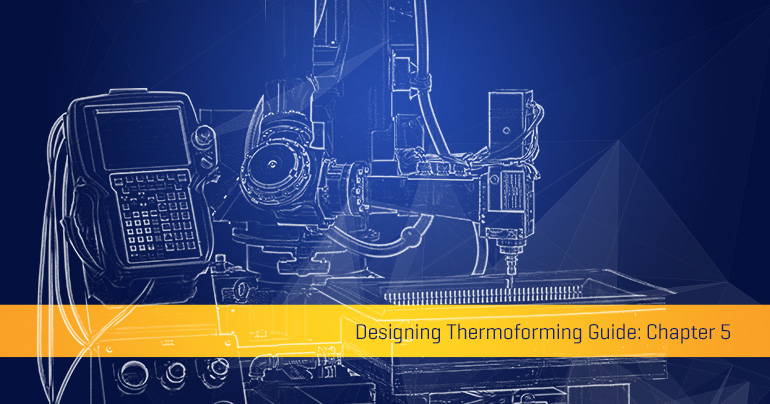
Every part that comes out of a thermoforming machine must be trimmed. In 1949 when Ray Products was founded, this process was carried out with hand tools. Today, we use high-precision 6-axis trimming robots to carry out the process quickly, and cost-effectively.

(more…)

Category: Thermoforming

This is the fifth post in our series from our Thermoforming Handbook, a guide that, until now, was only available to our customers and partners. We’re releasing the whole thing in a series of posts right here on our blog.

We’ve previously released:

If you’re someone who uses custom plastic manufacturing professionally and you’re interested in getting your own copy, just send us a message and we’ll be happy to send you one. As always, these are general guidelines. Any project or design needs to be reviewed by a qualified thermoforming professional before it goes into production, and the sooner you get one of those qualified professionals involved in the process, the smoother things tend to go.  If you’re looking for a qualified professional, we know a few who would be happy to help.


Open up an engineering textbook, and it’ll likely define tolerances as the “permissible limit or limits of variation.” To put it more simply, how close to your exact specification can you expect the final product to be?

Every manufacturing process has unique tolerances, and thermoforming is no different. It’s important to note that what we’re listing here are industry standard thermoforming tolerances. If you have a project that demands tolerances tighter than what is standard in the industry, we’d be happy to hear from you. Our team loves a good challenge.

(more…)

Category: Thermoforming

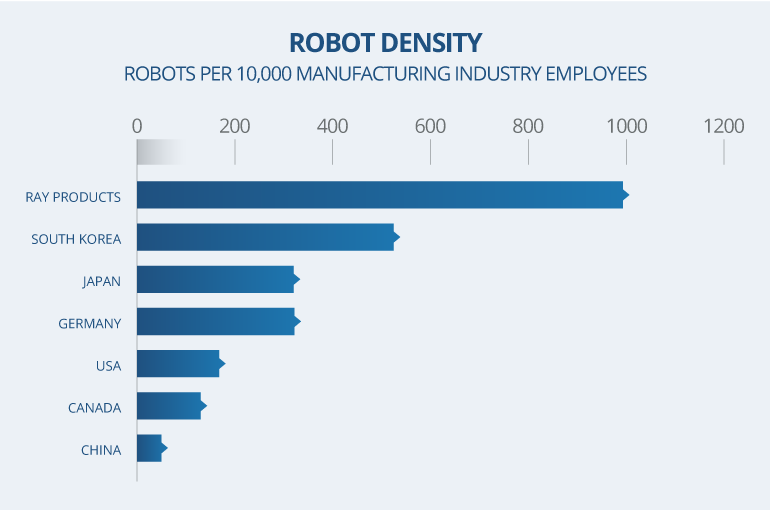
Recently, Plastics News published an interesting article with an interesting chart. The chart showed the “number of multipurpose industrial robots per 10,000 employees in the manufacturing industry.

Essentially, it’s one measure of how advanced each country’s manufacturing sector is.

China, with just 49 robots per 10,000 manufacturing industry employees, is at the low end. South Korea, with 531 robots per 10,000 employees, is at the top of the chart. The United States, with 176, is somewhere in the middle.

So, we wondered how we stacked up.

It turns out that, if Ray Products were a country, we’d have the most advanced, most automated manufacturing sector in the world.

Robot Density Per Employee

If only…

Category: Thermoforming

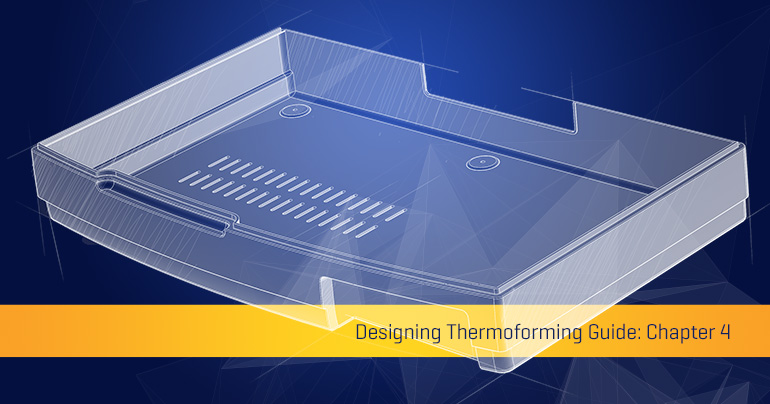
This is the fourth post in our series from our Thermoforming Handbook, a guide that, until now, was only available to our customers and partners. We’re releasing the whole thing in a series of posts right here on our blog.

We’ve previously released:

If you’re someone who uses custom plastic manufacturing professionally and you’re interested in getting your own copy, just send us a message and we’ll be happy to send you one. As always, these are general guidelines. Any project or design needs to be reviewed by a qualified thermoforming professional before it goes into production, and the sooner you get one of those qualified professionals involved in the process, the smoother things tend to go.  If you’re looking for a qualified professional, we know a few who would be happy to help.


(more…)

Category: Thermoforming

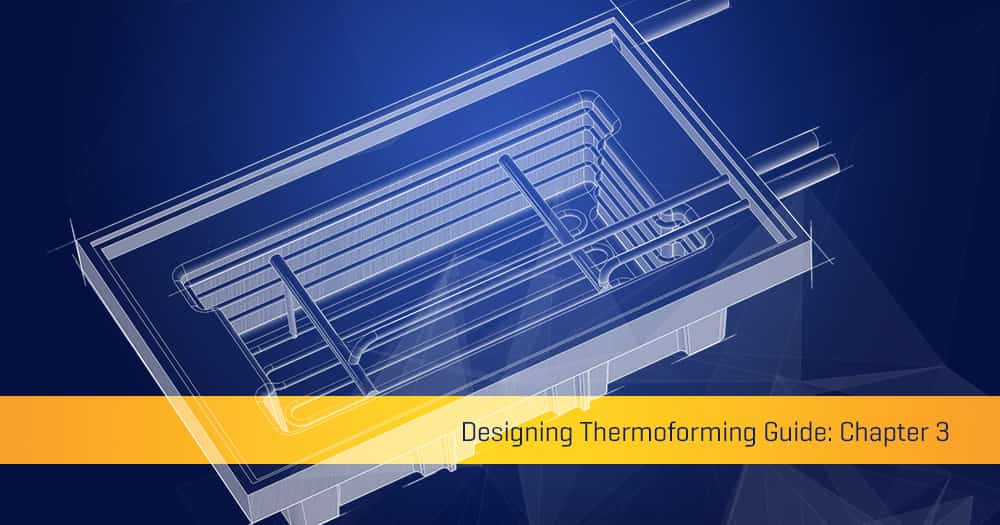
This is the third post in our series from our Thermoforming Handbook, a guide that, until now, was only available to our customers and partners. We’re releasing the whole thing in a series of posts right here on our blog.

We’ve previously released:

If you’re someone who uses custom plastic manufacturing professionally and you’re interested in getting your own copy, just send us a message and we’ll be happy to send you one. As always, these are general guidelines. Any project or design needs to be reviewed by a qualified thermoforming professional before it goes into production, and the sooner you get one of those qualified professionals involved in the process, the smoother things tend to go.  If you’re looking for a qualified professional, we know a few who would be happy to help.


(more…)

Category: Thermoforming

This is the second post in our series from our Thermoforming Handbook, a guide that, until now, was only available to our customers and partners. We’re releasing the whole thing in a series of posts right here on our blog. Chapter 1’s blog post is right here.

If you’re someone who uses custom plastic manufacturing professionally and you’re interested in getting your own copy, just send us a message and we’ll be happy to send you one. As always, these are general guidelines. Any project or design needs to be reviewed by a qualified thermoforming professional before it goes into production, and the sooner you get one of those qualified professionals involved in the process, the smoother things tend to go.  If you’re looking for a qualified professional, we know a few who would be happy to help.

Welcome to Chapter 2 of our design guide, where we’ll learn some important design considerations when designing for thermoforming. We’ll cover draw ratios, sharp angles, undercuts, draft angles and more. Thermoforming is a very capable process, and the more you understand about its technical aspects, the more flexibility you’ll have in design.

Draw Ratios

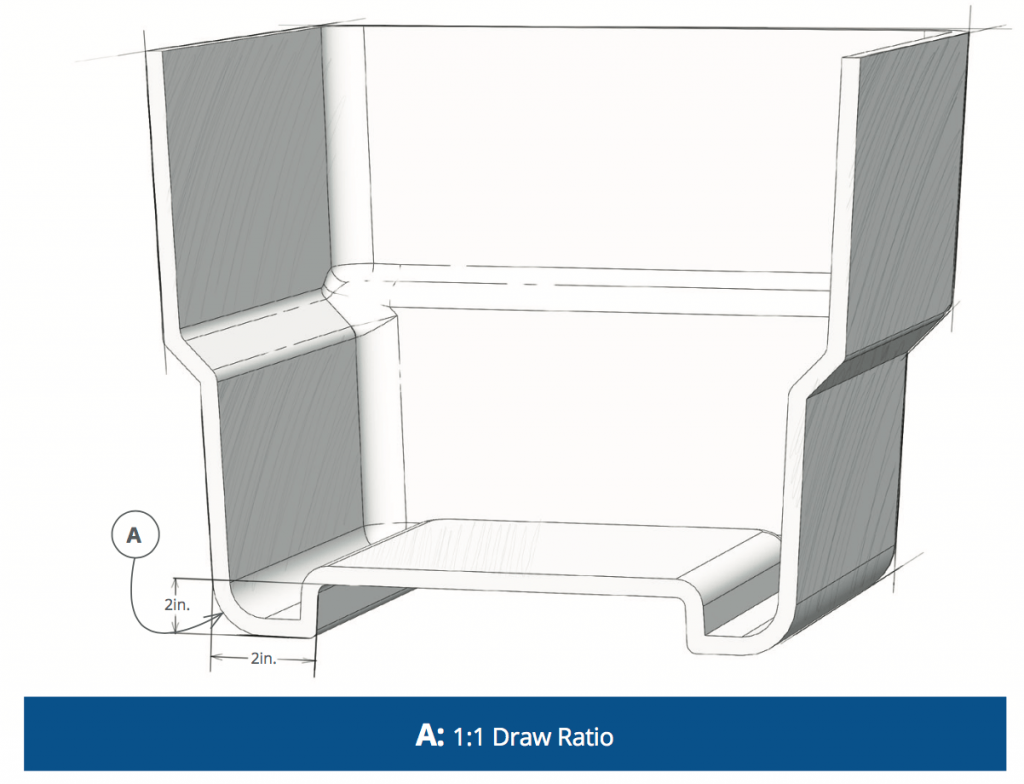
A draw ratio is the calculation that lets you know what gauge of plastic you need to start with for any given thermoformed part.

The Importance of Stretching

Thermoforming works by stretching a sheet of plastic over a mold. The more stretching that occurs, the thinner the plastic gets.

You Want It Thick, but Not Too Thick

Using a draw ratio calculation, you can make sure you start with plastic that’s thick enough to give you the final thickness you need, but not so thick that you waste money on overly expensive materials.


Thermoforming with a One to One Draw Ratio

(more…)

Category: Thermoforming

Medical Design & Outsourcing is running an article by our CEO Brian Ray that brings together ancient Egyptian spoons, thermoforming and 3D printing.

No, seriously.

Turns out that ancient Egyptians were some of the first thermoformers. Today, the modern version of a 5,000-year-old technique is helping to power everything from electric vehicles to cutting-edge medical devices. All at a cost that makes it easy to make the jump from prototyping to production.

Hopefully when The Mummy reboots in 2017, it’ll feature Tom Cruise discovering some thermoformed ancient Egyptian artifacts, shortly before he’s attacked by the undead. Fingers crossed.

Category: Thermoforming

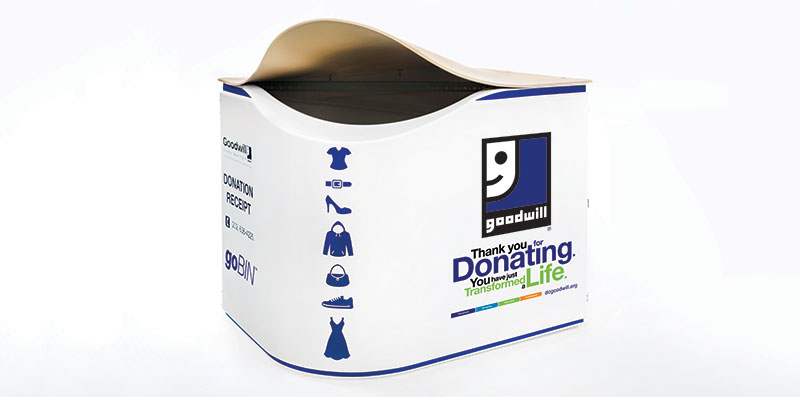
Plastics News wrote an article on our GoBin project for Goodwill Industries. If you’re not familiar with the GoBin, it’s a donation collection container that Goodwill is placing in the lobbies of apartment buildings and office complexes. The bins help make donating to Goodwill easier than ever.

The article touches on one of the key ways we were able to help the charitable organization. When Goodwill came to us with the original designs, the sides of the container were split into a 3-part assembly to accommodate another thermoformer with more standard sized equipment.

Thanks to our large, 10’ × 18’ thermoforming capabilities, we were able to accommodate the same design with a 2-part assembly. Eliminating the third part helped to cut per-unit costs, improve the rigidity of the final product and make it easier and quicker to assemble the GoBins when they’re delivered on-site.

But, don’t’ take our word for it. Head over to Plastics News and read the article.

How Can Ray Products Help You Today?